

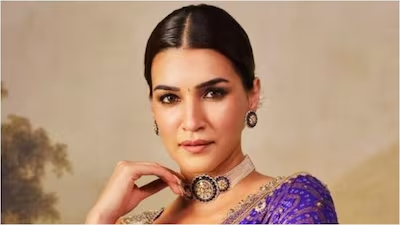
Bollywood actress Kriti Sanon has approached the Delhi High Court seeking protection of her personality rights, bringing renewed attention to the legal safeguards available to celebrities against certain unauthorised uses of their identity. The development was reported on October 16, 2026, when the court began examining the legal questions surrounding her plea.
During the hearing, Justice Purushaindra Kumar Kaurav asked Kriti Sanon’s counsel, advocate Pravin Anand, to submit relevant judgments, research papers and other legal material explaining the scope of personality rights. The court indicated that it wanted a broader understanding of the subject before considering a comprehensive order.
The case comes at a time when the unauthorised use of celebrity names, photographs, voices and likenesses has become an increasingly discussed legal issue, particularly because of developments in artificial intelligence and digital media.
The next hearing in Kriti Sanon’s personality rights case has been scheduled for October 29, 2026. As of the October 16 hearing, the court had sought further legal material, and a final decision on the relief sought by the actress had not been reported.
Why Has Kriti Sanon Approached the Delhi High Court?
Kriti Sanon has filed a plea seeking legal protection for her personality rights. These rights broadly concern a person’s ability to seek protection against certain unauthorised uses of their identity.
For a public figure, identity may include several recognisable elements, such as a name, face, voice, photograph, video or likeness. These elements can carry both personal and commercial value, especially for actors whose public image is closely associated with their professional work.
During the hearing, advocate Pravin Anand explained that personality rights could cover an individual’s name, voice, face, image, photographs and videos. He also highlighted concerns about the commercial use of someone’s identity without consent or authorisation.
The court requested a compilation of relevant legal judgments and research material to help clarify the legal principles involved.
However, the request for further research should not be interpreted as a final ruling in Kriti Sanon’s favour or against her. The court is examining the relevant legal questions before deciding how the matter should proceed.
What Are Personality Rights? Understanding the Legal Issue
Personality rights refer broadly to legal protections that may be available against certain forms of unauthorised exploitation of an individual’s identity. Depending on the circumstances, these issues may overlap with privacy, publicity rights, intellectual property and commercial interests.
In the entertainment industry, an actor’s identity can become a valuable professional asset. Their name, image and voice may be recognised by millions of people and can be associated with films, advertising campaigns, endorsements and other commercial activities.
Legal disputes can arise when these identifying features are used without appropriate permission in circumstances where the law provides protection.
For example, the use of an actor’s photograph in an advertisement might raise questions if it falsely suggests that the actor endorses a product. Similarly, an unauthorised imitation of a person’s voice or appearance may raise legal concerns depending on how it is created and presented.
Nevertheless, not every use of a celebrity’s name or photograph is automatically unlawful. News reporting, criticism, satire, artistic expression and other legitimate activities may involve different legal considerations.
This is one reason the scope of personality rights requires careful examination rather than a blanket assumption that every use of a public figure’s identity should be prohibited.
What Did the Delhi High Court Say During the Hearing?
The hearing on October 16 focused on understanding the scope of personality rights and the legal framework governing such disputes.
Justice Purushaindra Kumar Kaurav asked advocate Pravin Anand to provide relevant judgments, research papers and his understanding of the law. The court indicated that it wanted to examine the issue comprehensively rather than consider the matter only through the facts of the individual case.
The court also raised a question about whether the Delhi High Court’s Intellectual Property Division has the appropriate jurisdiction to hear personality rights disputes of this nature.
Jurisdiction refers to the legal authority of a court or a particular division to hear and decide a matter.
Anand submitted that there was no jurisdictional issue in Kriti Sanon’s case and indicated that the necessary compilation would be filed.
The court’s request suggests that it wants greater clarity on the applicable legal principles and the appropriate forum for these disputes. The matter was listed for further hearing on October 29, 2026.
How Is Artificial Intelligence Changing Celebrity Personality Rights?
Artificial intelligence has made it easier to generate or alter photographs, videos and audio recordings. While these technologies can support creative projects and entertainment, they can also raise concerns when used to imitate real people without appropriate authorisation.
AI-generated images may reproduce a person’s appearance, while synthetic audio tools can imitate recognisable voices. Digitally manipulated videos can also create misleading impressions about what someone has said or done.
For celebrities, such content may raise questions about consent, identity, reputation and commercial exploitation.
Potential concerns include:
- Unauthorised images: Using a celebrity’s likeness in contexts that may create a misleading impression.
- Voice imitation: Reproducing a recognisable voice in ways that raise legal or commercial concerns.
- Digital impersonation: Creating content that appears to come from a real person when it does not.
- Commercial exploitation: Using a public figure’s identity to promote a product or service without the necessary authorisation.
- Misleading endorsements: Suggesting that a celebrity supports a brand or product without a genuine endorsement.
These examples explain the broader relevance of personality rights, but they should not be treated as confirmed allegations in Kriti Sanon’s individual case unless supported by the court record.
The central legal question is how to protect a person’s identity while also preserving legitimate forms of expression, reporting and creativity.
Why Is This Case Important for Bollywood?
Celebrity identity is closely connected to professional opportunities in the film industry. Actors build public recognition through their performances, interviews, advertisements and other professional activities.
Their names and images can also acquire substantial commercial value. Consequently, questions about unauthorised use of celebrity identities can affect actors, brands, production companies, advertisers and digital content creators.
Kriti Sanon’s case adds to the growing discussion about how Indian courts should approach these disputes.
A clearer legal framework could help distinguish between uses that may warrant legal protection and those that fall within legitimate reporting, commentary, artistic activity or other lawful purposes.
At the same time, courts must consider the facts of each case. The legal position may depend on the nature of the content, the way the identity is used, the purpose of the use and the specific relief requested.
The court’s request for a broader compilation of legal precedents may therefore be significant beyond this particular proceeding.
Other Celebrities Who Have Sought Personality Rights Protection
Kriti Sanon is not the only public figure whose personality rights have been considered by the Delhi High Court.
According to reports, proceedings involving various actors, sportspersons and other public personalities have addressed questions surrounding the unauthorised use of identity.
Names mentioned in reporting on such cases include Kangana Ranaut, Tabu, Vijay Deverakonda, Allu Arjun, Kajol, R. Madhavan and Jr NTR. Cricketers and other public figures have also sought protection in separate proceedings.
These cases do not necessarily involve identical claims or outcomes. A court order in one person’s case does not automatically establish that another person will receive the same relief.
The growing number of disputes has, however, highlighted the need to examine the principles that should guide personality rights claims.
The Delhi High Court’s request for legal research in Kriti Sanon’s case reflects this wider discussion.
What Is the Difference Between Personality Rights and Privacy Rights?
Personality rights and privacy rights can overlap, but they are not identical concepts.
Privacy rights generally concern protection against certain intrusions into a person’s private life and personal information. Personality rights, in the context of celebrity disputes, may also concern the unauthorised commercial use of identifiable aspects of a person’s identity.
For example, a privacy dispute might concern the improper disclosure of private information. A personality rights dispute might concern the use of a celebrity’s image to suggest an endorsement without authorisation.
Some situations may involve both issues, while others may primarily raise questions about commercial identity, intellectual property or other legal principles.
In India, these matters can involve different sources of law and judicial precedents. Their application depends on the facts and the relevant legal grounds.
This distinction is important because a request for personality rights protection does not automatically mean that every public use of a celebrity’s identity is prohibited.
Could the Case Affect Future Celebrity Rights Disputes?
The case could contribute to the broader legal discussion about the scope of personality rights, particularly if the court’s consideration results in further clarification of the relevant principles.
Questions that may be important in such disputes include which identifying features receive protection, when unauthorised use becomes legally actionable, what evidence is required and how courts should assess requests for injunctions or other remedies.
The relationship between personality rights and freedom of expression is also significant.
Journalists may need to refer to public figures while reporting news. Film reviewers, artists and commentators may discuss celebrities as part of criticism or creative expression. Courts must consider these interests alongside any legitimate claim to protection against unauthorised exploitation.
A balanced legal approach needs to distinguish between harmful or misleading uses and legitimate forms of public discussion.
At this stage, however, it would be premature to predict the final outcome of Kriti Sanon’s case or claim that the court has established a new legal rule.
When Is the Next Hearing in Kriti Sanon’s Personality Rights Case?
The next hearing has been scheduled for October 29, 2026.
The court has asked Kriti Sanon’s counsel to submit relevant judgments and research material addressing the scope of personality rights and related jurisdictional questions.
The court will consider the material placed before it as the proceedings continue. The October 16 hearing did not establish a final outcome on the relief sought by the actress.
Readers should therefore distinguish between the filing of a petition, the court’s requests for further legal submissions and any eventual order granting or refusing relief.
Further developments will depend on the subsequent proceedings and the court’s assessment of the legal issues.

