

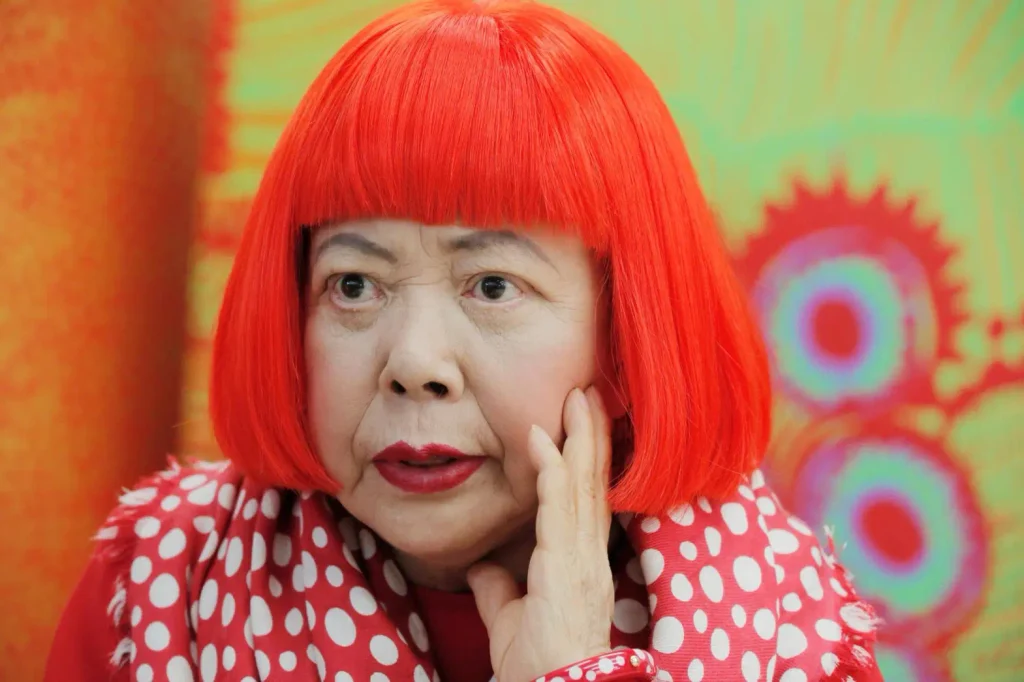
Yayoi Kusama, the Japanese artist whose polka dots turned into one of the most recognizable visual languages in modern art, has died at the age of 97. Her studio confirmed on Thursday that she passed away on August 14 at a hospital in Tokyo. No cause of death was given.
Kusama spent close to eight decades building a body of work that stretched from paintings and sculptures to entire rooms designed to make visitors feel like they had stepped inside her own imagination. Her studio said she kept painting until her final days, describing her lifelong work as an ongoing exploration of forever love and eternal soul.
What Is Yayoi Kusama Known For?
Kusama is best known for covering canvases, sculptures and entire rooms with repeating patterns, most famously dots, but also nets, swirls and worm like shapes. Her polka dot pumpkins became instantly recognizable pieces of contemporary art, appearing in galleries, outdoor installations and eventually on handbags, teacups and T shirts once fashion brands began working with her.
She was also known for her mirrored infinity rooms, spaces lined with mirrors and small lights that create the illusion of an endless universe stretching out in every direction. Those rooms turned into some of the most photographed art installations in the world, drawing long queues at museums simply for a few minutes inside.
Beyond the dots and pumpkins, Kusama worked across an unusually wide range of mediums for a single artist. She painted, sculpted, wrote novels, made films, and staged performance pieces, all while keeping her visual signature consistent enough that a single glance at almost any of her work makes it instantly identifiable as hers.
Yayoi Kusama’s Most Famous Piece
If there is one image most people associate with Kusama, it is the pumpkin. Her yellow and black spotted pumpkin sculptures, especially the giant outdoor version placed on Naoshima island in Japan, became one of the most photographed pieces of contemporary art anywhere in the world. The pumpkin motif appeared across her career in paintings, small sculptures and massive outdoor installations, and it eventually became something close to a personal emblem.
Her infinity mirror rooms are usually mentioned in the same breath. Works like Love Arrives at the Earth Carrying with it a Tale of the Cosmos, which she showed at the Tate Modern in London, and various versions of her Mirrored Corridor pieces, gave viewers a physical space to step into her recurring vision rather than simply looking at a canvas from a distance.
Other standout works from her career include Macaroni Girl, a figure covered entirely in macaroni that spoke to her fear of food, and The Visionary Flowers, a set of oversized twisting tulip sculptures. Together, these pieces show an artist who kept returning to the same core symbols while constantly finding new ways to scale and reshape them.
Where Kusama’s Artwork Has Been Shown
Kusama’s work has been exhibited at some of the most respected museums in the world, including the Museum of Modern Art, the Whitney Museum of American Art in New York, and the Museum Ludwig in Germany. That level of institutional recognition placed her among Japan’s most respected contemporary artists, and her retrospectives regularly drew crowds large enough to require timed entry tickets.
Her connection to Japan remained strong even after decades spent building her career in New York. She eventually returned to Tokyo, where she continued working from her studio for the rest of her life, and where her death was ultimately announced.
From Japan To New York And Back Again
Kusama’s path to becoming one of the most celebrated artists of her generation did not start with an easy road. She grew up in a middle class family in Japan that wanted her to focus on marriage rather than art. Instead of kimonos and a traditional path, she wanted paint and brushes, and she eventually decided the only way to fully pursue that was to leave the country.
In 1957, she became one of the first Japanese women to move to New York specifically to pursue an art career. At the time, the dominant style in American art was action painting, filled with dribbles and loose gestural marks, which stood in sharp contrast to the controlled, repetitive dot patterns Kusama was drawn to. She spent years in poverty and relative obscurity before her work started to gain wider attention.
While in New York, she built friendships with major figures in the art world, including Andy Warhol, Georgia O’Keeffe and Joseph Cornell, all of whom recognized something distinctive in her approach even when wider audiences had not yet caught on.
Yayoi Kusama And Joseph Cornell
Kusama never married and did not have children, but her relationship with fellow artist Joseph Cornell became one of the more well documented parts of her personal life. The two met in the early 1960s and remained close until Cornell’s death in the 1970s, exchanging frequent letters and phone calls throughout their friendship.
Their bond was widely described as deeply affectionate rather than a conventional romance, built more around shared artistic sensibility and emotional support than anything else. Cornell would occasionally give her pieces of his own work to help her through financial hardship, and after his death, some of the materials he had given her ended up folded into her own collage work.
Her Early Performances And Public Attention
Kusama did not build her reputation quietly. In the late 1960s, she staged anti war happenings where she painted polka dots directly onto people’s bodies, and on at least one occasion, a horse. Some of these performances led to arrests on obscenity charges, but they also generated the kind of media attention that helped push her work beyond the gallery world and into wider public awareness.
That willingness to blur the line between fine art and public spectacle became a defining part of her career, long before museums and fashion houses fully embraced her.
Later Recognition And Commercial Success
As decades passed, the art world caught up with what Kusama had been doing all along. In 2008, Christie’s auctioned one of her works for 5.8 million dollars, a signal that collectors had firmly recognized her market value. In 2016, Japan awarded her the Order of Culture, one of the country’s highest honors for artistic achievement.
Her later years also brought a different kind of fame. She collaborated with fashion brand Louis Vuitton, and her polka dot designs appeared across licensed products like teacups, T shirts and key chains. Life sized replicas of her likeness, usually shown in her signature bright wig, were used in store window displays and marketing campaigns, turning her into a recognizable public figure well beyond traditional art circles.
The Hallucinations Behind The Dots
Kusama often explained that her dot patterns were not simply a stylistic choice. She described experiencing hallucinations from a young age, including visions of dots and nets covering everything around her, and said her work was an attempt to represent the world exactly as she saw it. She spent time in and out of psychiatric care over the years, and in her later decades she lived at a hospital in Tokyo while continuing to work from a nearby studio.
Rather than treating this as something separate from her career, Kusama folded it directly into her creative identity. She spoke openly about her mental health in interviews, and much of her most iconic imagery grew directly out of those personal experiences rather than any outside artistic movement.
A Voice That Refused Easy Labels
Over the course of her career, critics tried on plenty of labels for Kusama, including pop artist, avant garde figure and feminist icon. She generally waved off most of these categories, treating them as convenient shorthand rather than an accurate description of what she was actually doing.
In a 2012 interview, she summed up her devotion to her signature pattern in typically direct terms, saying she wanted to create as many as a thousand or two thousand paintings and that she planned to keep painting until she died. That statement held up. Her studio said she continued painting right up until her final days.
Frequently Asked Questions
What is Yayoi Kusama known for?
Yayoi Kusama is known for her signature polka dot patterns, her giant pumpkin sculptures, and her mirrored infinity rooms that surround visitors with repeating lights and reflections. She worked across painting, sculpture, film, fashion collaborations and performance art.
What did Yayoi Kusama say about her hallucinations?
Kusama said she experienced hallucinations from childhood, including visions of dots and netting covering the world around her. She described her artwork as a way of representing the world exactly as she saw it, and she spent time in psychiatric care over the years while continuing to work.
What is Yayoi Kusama’s most famous piece?
Her polka dot pumpkin sculptures, particularly the large outdoor pumpkin on Naoshima island in Japan, are widely considered her most famous work. Her infinity mirror rooms are a close second in terms of public recognition.
Is Yayoi Kusama still alive?
No. Yayoi Kusama died on August 14, 2026, at a hospital in Tokyo at the age of 97, according to her studio.
Did Yayoi Kusama have a husband?
No. Kusama never married. Her closest personal relationship was with artist Joseph Cornell, whom she met in the early 1960s and remained close to until his death.
Where can you see Yayoi Kusama’s artwork?
Her work has been shown at major museums including the Museum of Modern Art, the Whitney Museum of American Art, the Museum Ludwig and the Tate Modern, along with permanent installations such as her pumpkin sculpture on Naoshima island in Japan.
What awards did Yayoi Kusama receive?
In 2016, Kusama received Japan’s Order of Culture, one of the country’s highest honors for artistic achievement. Her work has also achieved major auction results, including a piece sold by Christie’s for 5.8 million dollars in 2008.
