

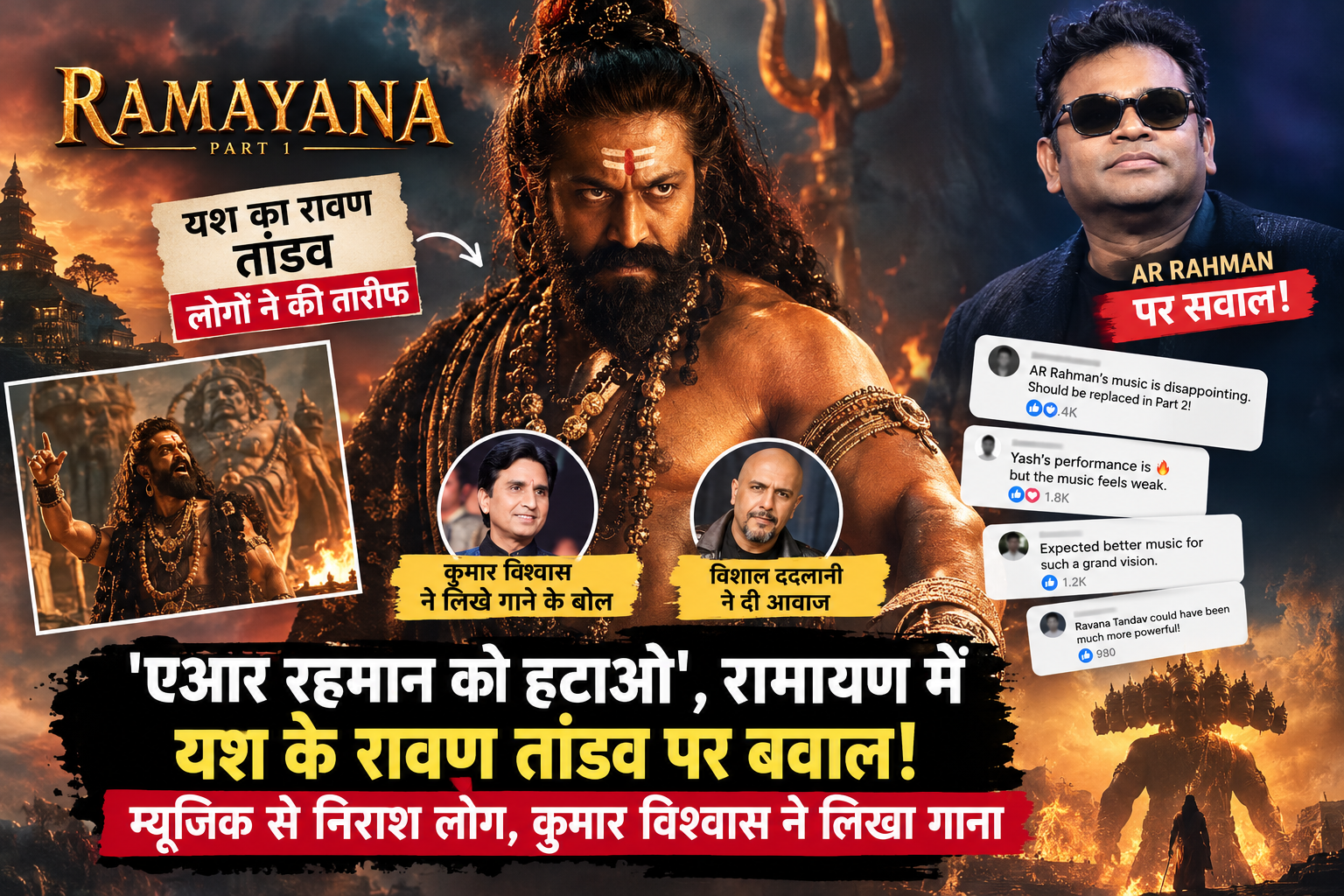
The much-anticipated Ramayana project has become a major talking point following the release of its new musical sequence, ‘Ravana Tandav’, featuring Yash as the powerful demon king Ravana. Unveiled around Dussehra on October 20, 2026, the song showcases Ravana’s devotion to Lord Shiva through an intense performance inspired by the Shiva Tandava Stotram.
While Yash’s commanding screen presence, expressions and energetic performance have attracted considerable appreciation, the music has received a mixed response online. Several viewers have expressed disappointment with the composition, with some even asking the makers to reconsider A.R. Rahman’s involvement in the sequel.
The debate has quickly become one of the most discussed aspects of the song’s release. Some listeners expected a more explosive musical arrangement to complement the scale of the mythological spectacle, while others believe the composition may work differently when experienced within the complete film.
Written by Dr. Kumar Vishwas in Hindi and sung by Vishal Dadlani, the track brings together prominent names from the Indian entertainment industry. The film’s music also involves German composer Hans Zimmer, making the project a significant musical collaboration.
However, the online discussion demonstrates that a major film’s promotional song can generate different expectations among viewers, particularly when it draws upon a familiar religious and cultural tradition.
Yash Wins Praise for His Powerful Ravana Avatar
One of the strongest talking points surrounding ‘Ravana Tandav’ is Yash’s transformation into Ravana.
Known internationally for his performance in the KGF franchise, Yash takes on a mythological character with a very different personality and cultural significance. In the newly released sequence, he appears as a fierce devotee of Lord Shiva, combining intense expressions with a commanding physical presence.
The video presents Ravana performing religious rituals before moving into the Tandav sequence. His appearance includes traditional ornaments, rudraksha accessories and sacred markings, creating a visual identity associated with the character’s devotion and formidable personality.
The performance has attracted praise from viewers who believe Yash brings the required intensity to the role. His movements, expressions and physicality have become major subjects of online discussion.
Many viewers have also appreciated the production design and visual presentation of the sequence. For fans anticipating the film, the song provides an extended glimpse of how the filmmakers intend to portray Ravana on the big screen.
Nevertheless, the reactions to the overall song have not been entirely positive. Some viewers have argued that while Yash’s performance is impressive, the musical arrangement does not deliver the same level of impact.
This difference between the response to the visuals and the music has become central to the ongoing debate.
Why Are Fans Asking for AR Rahman’s Replacement?
The criticism surrounding A.R. Rahman’s music emerged shortly after the release of ‘Ravana Tandav’. Social media discussions and online entertainment reports indicate that some listeners were expecting a more energetic, memorable and immediately impactful composition.
A number of users questioned whether the music matched the intensity of Yash’s portrayal of Ravana. Others suggested that the song could have benefited from a different musical direction.
Some viewers even called for Rahman to be replaced in the second instalment of Ramayana. Suggestions involving other Indian composers also appeared in online conversations.
These comments represent the opinions of some social media users rather than an official decision by the film’s producers. As of October 21, 2026, there has been no confirmed announcement that Rahman will be removed from the project.
It is also important to distinguish between criticism of an individual composition and a composer’s wider body of work. Rahman is an internationally recognised musician whose career includes Indian film soundtracks and international projects. The mixed response to one promotional track does not, by itself, establish the overall quality of his contribution to the film.
Music is subjective, and audiences approach mythological songs with different expectations. Some prefer traditional devotional arrangements, while others expect contemporary orchestration, powerful percussion and dramatic musical crescendos.
The reaction to ‘Ravana Tandav’ reflects this diversity of preferences. Whether viewers ultimately connect with the soundtrack may depend on how the music functions within the film’s complete narrative.
Kumar Vishwas Writes the Hindi Lyrics for Ravana Tandav
Another important aspect of the song is the involvement of poet and writer Dr. Kumar Vishwas, who has penned the Hindi lyrics.
The song draws upon the cultural association between Ravana and Lord Shiva. In Hindu tradition, Ravana is remembered not only as the king of Lanka but also as a devoted worshipper of Shiva. The Shiva Tandava Stotram is traditionally associated with his devotion to the deity.
The lyrics attempt to combine this devotional association with the dramatic presentation of Ravana as a powerful ruler.
Kumar Vishwas is widely recognised for his poetry and public recitations. His involvement in a large-scale mythological film has consequently attracted attention from audiences interested in the literary side of the project.
The song incorporates elements associated with the Shiva Tandava Stotram while presenting Ravana’s strength, devotion and larger-than-life personality.
The challenge for a film song based on a familiar religious tradition is to balance cultural recognition with the requirements of cinematic storytelling. Viewers may have strong expectations regarding the language, rhythm and emotional intensity of such a composition.
The response to the lyrics and music has therefore become part of a broader conversation about how the makers are interpreting the Ramayana for contemporary cinema.
Vishal Dadlani’s Voice Adds Intensity to the Song
Vishal Dadlani has lent his voice to the Hindi version of ‘Ravana Tandav’. Known for his energetic singing style, Dadlani has performed numerous high-energy songs across Hindi cinema.
His vocal delivery is an important component of the track’s dramatic presentation. The song combines devotional references with a powerful portrayal of Ravana, requiring a performance that can complement the visual scale of the sequence.
However, the overall impact of a song depends on several elements working together. Vocals, composition, lyrics, percussion, orchestration, editing and choreography all influence how audiences experience a musical sequence.
In the case of ‘Ravana Tandav’, viewers have responded differently to these individual components. While many have praised Yash and the visual presentation, some listeners have questioned the music’s ability to create the expected excitement.
The debate does not necessarily mean that every element of the track has been rejected. Instead, it shows that audiences can appreciate a performance while remaining divided over the music accompanying it.
AR Rahman and Hans Zimmer’s Ramayana Collaboration
The musical team associated with Ramayana has generated considerable anticipation because of the involvement of A.R. Rahman and Hans Zimmer.
Rahman has composed music for numerous Indian films and earned international recognition for his work. Zimmer, meanwhile, is known for his scores for major international productions, including The Lion King, Gladiator and Dune.
Their collaboration on Ramayana has raised expectations about the film’s musical identity and its attempt to present an Indian epic to a global audience.
The project offers an opportunity to bring together different musical traditions and approaches to cinematic scoring. However, combining Indian devotional influences with large-scale orchestration is a creative challenge that requires a careful balance between familiarity and experimentation.
The response to ‘Ravana Tandav’ suggests that some listeners expected a more immediately recognisable musical hook or a stronger build-up in intensity.
Others may prefer a composition that develops gradually and gains additional meaning when paired with the film’s imagery and narrative.
The song’s reception will remain a matter of audience interpretation until more of the soundtrack and the finished film become available.
What Is Ravana Tandav About?
‘Ravana Tandav’ focuses on Ravana’s devotion to Lord Shiva and presents the character through a dramatic musical sequence.
In Hindu mythology, Ravana is a complex figure associated with extraordinary knowledge, immense power, pride and devotion. His relationship with Shiva is an important part of many traditional accounts of his character.
The Tandav is associated with Lord Shiva’s cosmic dance. It represents powerful cosmic forces and is often depicted through energetic movements, rhythmic patterns and dramatic imagery.
The Shiva Tandava Stotram is a celebrated hymn praising Shiva’s attributes and the grandeur of his dance. Its rhythmic language makes it a natural source of inspiration for a cinematic sequence centred on devotion and intensity.
The Ramayana song uses this cultural background to establish Ravana’s religious devotion while highlighting his imposing presence.
By focusing on this aspect of Ravana’s identity, the filmmakers appear to be presenting a character who is more complex than a conventional villain. His devotion and power are central to the visual and musical treatment.
The challenge is to portray this complexity without losing sight of the larger epic and its central narrative.
Ramayana Movie: Cast, Director and Release Details
Directed by Nitesh Tiwari and produced by Namit Malhotra, Ramayana is an ambitious cinematic adaptation of the ancient Indian epic.
The principal cast includes:
- Ranbir Kapoor as Lord Rama
- Sai Pallavi as Sita
- Yash as Ravana
- Sunny Deol as Lord Hanuman
- Ravi Dubey as Lakshman
The film also features other established performers in supporting roles.
The project has attracted attention for its scale, visual effects, casting and plans for a two-part cinematic presentation. Its music is another major element of the production, particularly because the story is deeply connected with Indian cultural and religious traditions.
The first instalment is scheduled for a theatrical release on November 5, 2026, according to reports available on October 21, 2026.
The release of ‘Ravana Tandav’ serves as a promotional opportunity to introduce audiences to Yash’s interpretation of Ravana ahead of the film’s arrival in cinemas.
The song has also generated discussion about how the film will balance spectacle, characterisation, music and storytelling.
Can the Song’s Reception Affect Expectations for Ramayana?
The mixed response to ‘Ravana Tandav’ highlights the challenge of promoting a large-scale film through individual musical releases.
A promotional song is often judged independently of the film. Viewers assess its melody, lyrics, vocals, visuals and immediate emotional impact without necessarily knowing how it will function within the complete story.
This can create a difference between the expectations of listeners and the creative intentions of the filmmakers.
For a mythological production such as Ramayana, audience expectations may be particularly high because many viewers already have a personal or cultural connection with the source material.
Some listeners may prefer traditional musical arrangements, while others welcome modern interpretations. A composition that appeals to one group may not satisfy another.
The online debate also illustrates how the performance of an actor can receive a different response from the music supporting that performance.
Yash’s portrayal has attracted praise from many viewers, but the soundtrack has generated criticism from some of the same audiences.
Ultimately, the complete film will provide a broader context for judging the music. Until then, online reactions should be understood as early audience opinions rather than a definitive assessment of the film’s soundtrack.

