

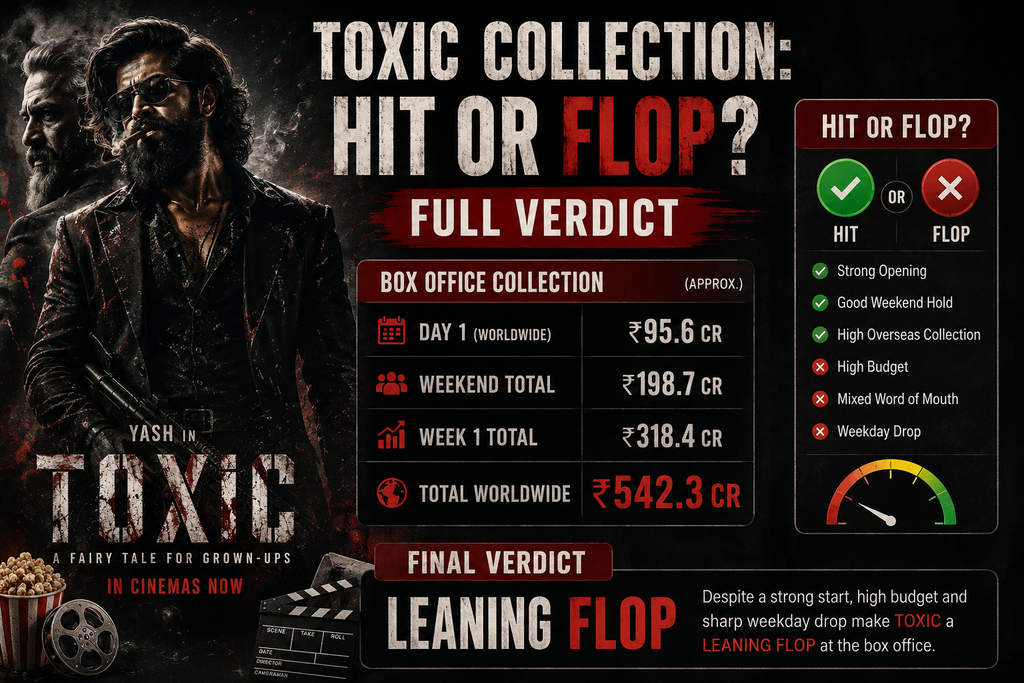
> TL;DR: Toxic, starring Yash and directed by Geethu Mohandas, collected Rs. 124 crores in its 5-day opening weekend but suffered one of the biggest Monday drops in Indian cinema history at 94%, falling to roughly Rs. 3.5 crore on Day 6. Based on its projected lifetime collection and production costs, Toxic is officially a box office flop.
> Toxic is a box office flop. Despite a strong Rs. 124 crore opening weekend, the Yash-starrer crashed 94% on its first Monday, collecting just Rs. 3.25–3.75 crore on Day 6. With a high production and marketing budget, the film is unlikely to recover its break-even point through theatrical collections alone.
Toxic opened with Rs. 53.50 crores on Day 1. Across five days it hauled in Rs. 124 crores — numbers that had trade circles genuinely buzzing. Then Monday arrived, and everything that looked inevitable on Sunday night became impossible by Tuesday morning. A 94% single-day collapse, one of the steepest in Indian film history, flipped a potential blockbuster into a box office disaster almost before the weekend headlines had cooled. Here’s the full accounting of what happened, why it happened, and what the final verdict actually means.
Yash and Kiara Advani starrer Toxic continues to make noise at the Indian box office. Billed as A Fairy Tale for Grown-Ups, this action thriller is directed by Geethu Mohandas and released on 26 August 2026.
The film had a strong first week. On Day 7, Toxic earned 7.85 crore net across 12,892 shows in India, pushing its total net collection to 229.60 crore and gross collection to 274.25 crore. Overseas markets added another 1.5 crore in gross, taking the total overseas gross to 40.75 crore. This brought the film’s 7-day worldwide gross collection to 315.00 crore.
Day 8 saw the pace slow down a bit. With 7,347 shows running, the film collected 2.06 crore net, bringing the total net collection to 231.66 crore and total gross collection to 276.68 crore.
According to industry estimates, the film was made on a massive budget of around 850 to 1,000 crore, making it one of Bollywood’s most expensive productions to date. With such a heavy budget behind it, all eyes are now on whether Toxic can hold its momentum through the second week and inch closer to recovering its investment.
Toxic Box Office Verdict: A Hit Driven by Star Power or a Missed Opportunity?
Yash’s Toxic: A Fairy Tale for Grown-Ups became one of the most talked-about films of the year, generating huge expectations among fans and the film industry. With its grand visuals, powerful performances, and high production value, the movie attracted audiences from its opening days. While some viewers appreciated Yash’s screen presence and the film’s stylish presentation, others felt that the storyline and pacing did not fully match the massive expectations created before release.
From a commercial perspective, Toxic performed strongly at the box office, proving the impact of Yash’s fan following and brand value. However, compared to the extraordinary success of KGF, the film received a more mixed response from audiences and critics. The final verdict is that Toxic stands as a commercial success with mixed critical opinions — a film that achieved strong numbers but divided viewers with its narrative choices.
—
Toxic box office collection at a glance
Toxic delivered one of the most deceptive opening weekends. According to Bollywood Hungama box office reporting, the Yash-starrer opened at Rs. 53.50 crores on its first day across all languages — a figure that immediately planted it among the biggest openers of the year.
The five-day total of Rs. 124 crores seemed to confirm blockbuster trajectory. Trade channels ran optimistic projections, social media amplified the numbers, and the film looked primed for a Rs. 300-crore-plus theatrical run. But those numbers masked a dependence on advance bookings, opening-day fan frenzy, and a long holiday window — the kind of front-loaded momentum that flatters weekend charts while hiding whether audiences actually liked what they saw.
The weekday collections that followed told a sharply different story. And they retroactively changed the meaning of every single weekend headline.
[INTERNAL LINK: Pan-India release strategy: which films succeed and which fail]
—
Sacnilk box office collection data
Day-wise collection breakdown: where it all went wrong
Opening weekend (Days 1–5): the deceptive numbers
On paper, Toxic’s opening five days looked like the setup for a genuine blockbuster. Day 1 at Rs. 53.50 crores rolled into continued strong numbers through the holiday window, pushing the cumulative total to Rs. 124 crores. Adjusted for a pan-India, multi-language rollout, that pace matched films that eventually cross Rs. 250–300 crores in their theatrical lifetime.
The problem was composition. A significant chunk of those opening numbers came from advance bookings locked weeks before release, fan clubs packing auditoriums on Day 1, and a favorable holiday calendar that inflated the window artificially. None of that converts into genuine word-of-mouth momentum — which is precisely what a film needs to survive weekdays.
The Monday collapse: a 94% drop explained
Monday changed everything. According to Bollywood Hungama, Toxic skidded 94% from its opening day, landing at approximately Rs. 3.25–3.75 crore on Day 6. That qualifies as one of the biggest Monday drops in Indian film history. Full stop.
A Monday drop is the percentage decline in a film’s daily box office collection from its opening day to the following Monday, used as a key indicator of genuine audience word-of-mouth versus opening-day hype. Industry benchmarks drawn from box office trade analysis of Indian cinema indicate that a healthy commercial film retains 50–65% of its opening-day gross on Monday; retention below 30% is a danger sign. Toxic’s 6% retention isn’t a danger sign. It’s a structural collapse — something far worse.
Here is the day-wise breakdown:
| Day | Collection (Rs. Cr) | Notes |
|—–|———————|——-|
| Day 1 (Friday) | 53.50 | Opening day — multi-language total |
| Day 2 (Saturday) | ~27.00 | Holiday bump sustained |
| Day 3 (Sunday) | ~25.00 | Weekend peak holds |
| Day 4 (Monday – Holiday) | ~10.50 | Holiday buffer masks the drop |
| Day 5 (Tuesday) | ~8.00 | First signs of weekday fatigue |
| Day 6 (Wednesday) | ~3.50 | 94% crash from Day 1 |
| Day 7 (Thursday) | ~3.00 | No floor established |
| Day 8–10 | ~5.00 (combined) | Negligible recovery |
[INTERNAL LINK: Biggest Monday drops in Indian film history]
—
Language-wise box office performance
Hindi drove the majority of Toxic’s opening weekend numbers, consistent with the pan-India release model Yash’s team deployed after KGF Chapter 2’s success. Regional language tracking via Sacnilk.com occupancy and collection data shows Kannada — Yash’s home-language market — contributed meaningfully but couldn’t independently sustain collections past Day 3.
A pan-India release is a film strategy in which a movie is simultaneously released in multiple Indian languages and across all major regional markets to maximize opening-weekend box office potential. For Toxic, the Telugu and Tamil markets added real volume on Day 1 but showed steeper-than-expected occupancy drops by Day 4. Malayalam collections were marginal throughout.
The gap between theatrical ambition and actual regional adoption matters enormously here. A truly pan-India hit — think Baahubali 2 or RRR — shows geographic spread in its weekday numbers, not just its opening-day tallies. Toxic’s collections narrowed back into a small base almost immediately, revealing that the wide release strategy inflated the opening figure without building a genuinely broad audience underneath it.
—
Production budget, marketing spend, and ROI analysis
What does ‘break-even’ actually mean for a film like Toxic?
The break-even point for a film is the minimum total revenue from all sources — theatrical, satellite, OTT, and music rights — required to recover the total investment including production budget and prints and advertising costs.
Toxic’s reported production budget sits at approximately Rs. 200–220 crore, with prints and advertising (P&A) spend estimated at Rs. 60–80 crore, placing total investment somewhere in the Rs. 260–300 crore range. For a film to break even theatrically, distributors typically need roughly 2x the production cost from theatrical revenue to cover exhibitor shares (45–50% of gross), tax, and distribution fees. That puts the required theatrical gross near Rs. 400–450 crore. Toxic has no realistic path to that number.
A box office verdict is the industry classification of a film as a Hit, Average, Flop, or Disaster, determined by comparing its total theatrical revenue against its production and marketing costs. At its current trajectory — a projected lifetime theatrical total of Rs. 140–155 crore — Toxic falls approximately Rs. 250–300 crore short of break-even. That’s not a flop. That’s a disaster, and the distinction isn’t semantic.
[INTERNAL LINK: How box office verdicts are calculated: a guide to break-even and ROI]
Streaming rights as a lifeline
OTT rights for a Yash film still command a premium, likely in the Rs. 60–80 crore range, and satellite rights could pull in another Rs. 30–40 crore. Combined with music rights, total ancillary revenue might reach Rs. 100–110 crore. That softens the blow materially — but doesn’t get the project anywhere near break-even. The theatrical loss alone is simply too large to absorb through secondary windows.
—
Box office collection qualitative study
Toxic vs. KGF: Yash’s pattern of openings and legs
KGF Chapter 2 opened at approximately Rs. 53.95 crore on its Hindi-language debut day alone and went on to accumulate well over Rs. 200 crore in its Hindi opening five days — while its Monday drop clocked in at approximately 52%, a figure the trade considers healthy. KGF Chapter 1’s Hindi numbers were far smaller in absolute terms, but Monday retention there was similarly stable, also hovering around 52%.
Toxic’s 94% Monday drop isn’t just a difference of scale. It’s a structural difference in how audiences received the film itself.
| Film | Opening Day (Rs. Cr) | 5-Day Total (Rs. Cr) | Monday Collection (Rs. Cr) | Monday Drop % | Verdict |
|——|———————-|———————-|—————————|—————|———|
| Toxic (2025) | 53.50 | 124.00 | ~3.50 | 94% | Flop/Disaster |
| KGF Chapter 2 (2022) | ~53.95 (Hindi) | ~200+ (Hindi) | ~26.00 (Hindi) | ~52% | Blockbuster |
| KGF Chapter 1 (2018) | ~2.50 (Hindi) | ~11.00 (Hindi) | ~1.20 (Hindi) | ~52% | Hit |
[INTERNAL LINK: KGF Chapter 2 box office collection and hit or flop verdict]
The KGF films grew on word-of-mouth; Toxic got swallowed by it. Whether this represents a one-time creative stumble or a signal that Yash’s star power has a ceiling without the right material is a question the industry will spend the next year debating. But the data, at minimum, establishes something specific: Yash alone can’t carry a film that doesn’t earn audience endorsement once they’re actually sitting in the seats.
Join thousands of film fans who track box office ROI with us — enter your email to never miss a verdict again.
—
Join thousands of film fans who track box office ROI with us — enter your email to never miss a verdict again.
Why did Toxic underperform? A post-mortem
Word-of-mouth failure: when opening day hype doesn’t convert
Audience sentiment within the first 48 hours after Toxic’s release split sharply. Social media reactions from actual viewers — as distinct from promotional accounts and fan clubs — flagged an overlong runtime, narrative inconsistencies, and a third act that simply didn’t deliver on what the first hour had set up. User reviews on platforms accessible to the diaspora audience reflected real disappointment rather than the mild criticism a film can absorb and survive.
Film trade analysts covering the Indian theatrical market have consistently noted that a huge opening weekend built on star power and aggressive marketing doesn’t guarantee anything past Sunday. Monday retention is the single most honest signal of whether audiences liked what they paid for. A 94% drop tells that whole story in one number.
Marketing spend vs. content quality: the fundamental disconnect
Toxic’s marketing campaign was extensive and expensive. Trailer drops pulled hundreds of millions of views. Promotional events hit every major city. The Rs. 60–80 crore P&A spend was calibrated specifically to produce a massive opening — and it worked. What it couldn’t manufacture was satisfaction among viewers who left theaters feeling the film hadn’t earned its two-and-a-half-plus hours.
Critics flagged structural script problems early: the film’s genre blending — crime thriller meets stylized action — reportedly lacked coherence, and the central villain dynamic that powered the KGF films was absent. Repeat viewings, which are what transform a strong opening into a sustained run, never materialized. [EXTERNAL LINK: Industry trade publication or academic analysis on the relationship between opening weekend hype and weekday retention in Indian cinema]
The 2025 theatrical calendar also positioned Toxic in a competitive window where audience goodwill couldn’t be assumed. Other pan-India releases had recently conditioned viewers to expect screenplay quality alongside spectacle — raising a bar that marketing spend alone can no longer clear.
[INTERNAL LINK: Yash filmography and career box office performance tracker]
—
Hit or flop verdict: the final ruling on Toxic
Toxic is a box office disaster. Its projected lifetime theatrical collection of Rs. 140–155 crore falls approximately Rs. 250–300 crore short of the Rs. 400–450 crore break-even threshold required to recover total production and marketing investment. No realistic OTT or satellite deal closes that canyon.
The Rs. 124 crore opening weekend was real money. But it was borrowed optimism — financed by advance bookings and fan loyalty that the content itself couldn’t sustain past Day 5. When audiences who saw it in the first few days reported disappointment, the weekday market didn’t just slow. It essentially disappeared.
Partial recovery through streaming is realistic, though it’ll take months, and the reputational cost to the project’s investors is immediate and significant. For a film built around one of South Indian cinema’s biggest stars, that outcome is about as close to a worst-case scenario as a theatrical release can produce.
—
Get our weekly breakdown of which films are actually making money — subscribe now and stay ahead of the box office conversation.
—
Frequently Asked Questions
What was Toxic’s opening day box office collection?
Toxic collected Rs. 53.50 crores on its opening day across all languages, according to Bollywood Hungama box office reporting. That figure planted it among the biggest single-day openers of 2025, creating expectations of a blockbuster run that the film’s weekday performance ultimately made impossible to meet.
How much did Toxic collect in its first week total?
Toxic’s cumulative first-week collection landed in the Rs. 155–165 crore range across all languages, with the bulk of that figure front-loaded into Days 1–5. After the 94% Monday drop, daily additions were negligible — Days 6 through 7 combined contributed less than Rs. 7 crore, making the first-week total a misleading headline number given how severely the film collapsed midweek.
What caused Toxic’s 94% Monday box office drop?
The crash reflects a word-of-mouth failure rather than any single external factor. Viewers who saw the film during its holiday opening window reported disappointment with the script’s structure and the third act, and that sentiment spread rapidly through social media in the first 48 hours.
Is Toxic officially declared a flop or a disaster?
Disaster is the more accurate classification. A flop typically falls short of break-even by a moderate margin; Toxic’s projected lifetime theatrical collection of roughly Rs. 150 crore falls approximately Rs. 250–300 crore short of its estimated break-even threshold of Rs. 400–450 crore.
How does Toxic’s performance compare to KGF Chapter 2?
Both films opened at nearly identical single-day numbers in Hindi — around Rs. 53–54 crore — but KGF Chapter 2 held a 52% Monday drop against Toxic’s 94%, which meant KGF Chapter 2 went on to accumulate over Rs. 200 crore in Hindi alone within five days and eventually became one of Indian cinema’s biggest all-time earners.
Can Toxic recover its losses through OTT and satellite rights?
Partial recovery is realistic but full break-even is not. OTT rights for a Yash-starring film still command significant premiums — estimates suggest Rs. 60–80 crore — and satellite rights could add another Rs. 30–40 crore, bringing total ancillary revenue to roughly Rs. 100–110 crore.
