


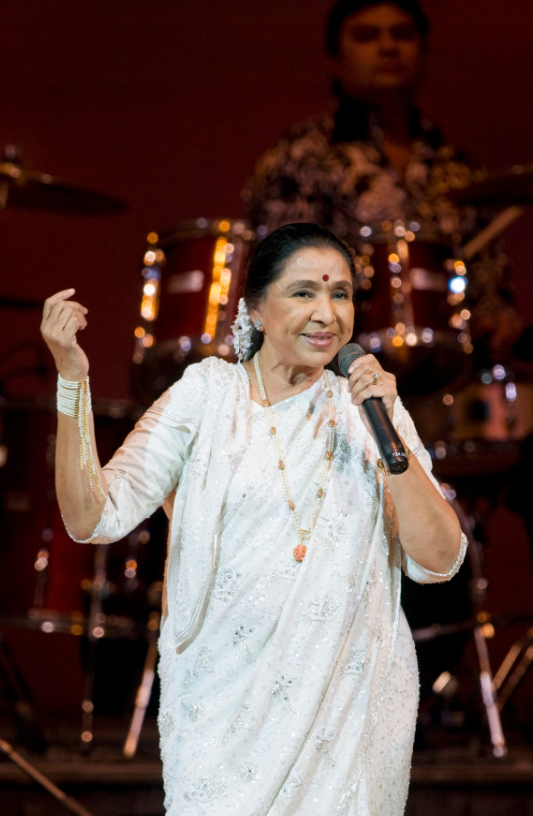
The passing of Asha Bhosle at the age of 92 marks the end of an extraordinary chapter in Indian music. One that refused to be confined by labels, genres, or expectations. With a career spanning over eight decades and more than 12,000 songs across 20+ languages, Bhosle leaves behind a legacy that is as vast as it is unmatched.
Often standing in the towering shadow of her elder sister Lata Mangeshkar, who was revered as the “nightingale of India,” Asha Bhosle carved her own path one that was less about purity and more about personality, expression and fearless experimentation. Where the industry had already defined its ideal voice, Bhosle found space in the margins and turned those margins into her stage.
Her voice belonged to the streets, the smoky clubs, the cabaret floors, and the restless night. It carried mischief, desire, playfulness and depth often all at once. She could be flirtatious in one moment and profoundly classical in the next. From sensuous cabaret numbers to delicate ghazals, her versatility became her greatest strength.
Born in Sangli and raised in Kolhapur after the family moved from Pune, Bhosle’s early years were shaped by both hardship and exposure to diverse influences. Even as a child, she was drawn to global cinema and music, often mimicking performances with a flair that hinted at her future. Her journey into playback singing began early, but recognition came gradually in an industry already dominated by established names.
Her breakthrough phase came with composer O P Nayyar, whose collaboration with her in films like Naya Daur gave her a distinct identity. Songs like “Aaiye Meherbaan” and “Yeh Reshmi Zulfein” showcased her ability to infuse songs with character and mood. Later, her association with R D Burman in the 1970s elevated her career to new heights. Tracks like “Piya Tu Ab To Aaja,” “Dum Maro Dum,” and “Chura Liya Hai Tumne” became cultural milestones, redefining the soundscape of Hindi cinema.
Yet, Bhosle was never limited to one style. Her classical brilliance shone in Umrao Jaan (1981), earning her a National Award decades after she began singing. In later years, she continued to evolve recording ghazals, collaborating internationally, and even earning Grammy nominations, a rare feat for an Indian playback singer.
Beyond music, her life was marked by personal struggles and resilience. From an early marriage that ended in separation to rebuilding her career on her own terms, Bhosle’s journey was as layered as her voice.
Even in her later years, she remained active and experimental. At 90, she performed live with the same energy that had defined her youth a testament to her enduring passion for music.
Her passing has drawn tributes from across the country, with leaders and artists remembering her as not just a singer, but an era in herself. And perhaps that is the most fitting way to remember Asha Bhosle not as a voice that followed rules, but as one that rewrote them.
Her music, like her spirit, will remain timeless.

